


Exploring Sectoral Approaches to CSR: A Comparative Analysis of IT, Manufacturing, and FMCG Companies in India
N.Krishnaveni1, Dr. Gopi Srinivasa Rao. S2, Dr. A. Sri Nagesh3
1Department of of Management Sciences, R.V.R&J.C College of Engineering, Guntur, A.P, India.
2Department of Management Sciences, Vignan Foundation for Science Technology and Research (Deemed to be University), Guntur, A.P, India.
3Department of Computer Science and Business Systems, R.V.R&J.C College of Engineering, Guntur, A.P, India.
1email: nkrishnaveni.mba,2email: gssgopi9@gmail.com,3email: asrinagesh@gmail.com @gmail.com
------------------------------------------------------------------------------------------------------------------------------------------------------------
ABSTRACTThere are two objectives of this study: one is to compare the Corporate Social Responsibility (CSR) strategies of the Information Technology (IT), Manufacturing and Fast-Moving Consumer Goods (FMCG) sectors of India in terms of thematic focus, financial investment and implementation in the communities. The study discovers sector specific variations in CSR through secondary data from annual reports (2018–2023), CSR portals published by government agencies, and industry specific studies, supplemented by systematic review of academic literature. Industry 4.0: IT Sector: Industrial revolution 4:0 puts digital literacy and technological empowerment as key priority areas, and companies in the IT sector are using their inherent core competencies to fill these skill gaps. The Manufacturing sector focuses on environmental sustainability, investing in green infrastructure and circular economy practices to align with climate agendas on a global scale. The FMCG sector, on the other hand, spends on sustainable sourcing and rural development which tackle supply chain ethics as well as farmer livelihood issues. Although all sectors align CSR with business objectives, the study complains about fragmented implementation and poor cross-sector synergies. It promotes collaborative frameworks (for example, public-private partnerships and sector-agnostic funding pools) that improve the scalability of existing solutions, optimize resources, and encourage measurable social impact. These insights provide actionable solutions for policymakers and corporate leaders to align India’s CSR landscape with Sustainable Development Goals (SDGs).
Keywords:Community Impact, Corporate Social Responsibility (CSR), Digital literacy, FMCG Sector, IT Sector, Manufacturing Sector, Sustainable Development Goals (SDGs).
1. INTRODUCTIONIn the Indian context, CSR research has received a lot of attention in recent years, which is particularly true in the context of different sectors. IT industries mainly centre around the community and educational initiatives, resulting in sharpening digital literacy (Pahuja, 2018) For instance, TCS has invested heavily in educational programs for underprivileged youth, complementing its strategic direction with community development. By contrast, the CSR activities in the Manufacturing sector have primarily focused on environmental sustainability. Tata Steel is an organization for which the successful integration of CSR strategy that addresses environmental conservation as well as community welfare (e.g., water conservation, renewable energy projects) has been observed by Gupta and Singh (2021). In contrast, the FMCG sector takes a different approach, focusing mainly on sustainable sourcing and health initiatives. According to Sharma (2020), companies such as Hindustan Unilever are focusing on rural development and health, responding to local community needs for sustainable business practices. While these insights are illuminating, the majority of studies focus on specific aspects of CSR, with little exploration of what constitutes CSR effectiveness on a larger scale, creating a considerable gap between comparative analyses across industries. We aim to fill this gap by comparing CSR initiatives across various sectors, the IT, Manufacturing and FMCG sectors.
2. LITERATURE REVIEWThis has led to extensive research on Corporate Social Responsibility, especially with reference to different sectors in the Indian context. The IT sector largely focuses on community initiatives and educational programs and has greatly helped in making communities digitally literate (Pahuja 20181). For example, companies such as TCS have invested heavily in educating the underprivileged youth there such that their strategic goals are in line with community development. On the other hand, CSR efforts in the Manufacturing sector have mainly revolved around environmental sustainability. According to Gupta and Singh (2021)2 organizations like Tata Steel successfully inculcate CSR modules which address environmental conservation as well as community welfare through water conservation and renewable energy factors. Meanwhile, the FMCG sector takes another route focusing on sustainable sourcing and health. As a strategy Sharma (2020)3 highlights that companies inhibit rural development and health and take care of the, needs of local communities to ensure sustainability of their business, as done by Hindustan Unilever. Nonetheless, there exists an appreciable void in terms of comparative analyses between sectors, as much of the research thus far has been sector-specific in their exploration of various constituents of CSR, without significant attention to how those elements interact to drive holistic CSR output. This study seeks to address this gap by performing a detailed comparison of CSR activities across IT, Manufacturing and FMCG industry sectors.
Research GapHowever, a limited comparative study exists between IT, Manufacturing, and FMCG sectors in India when it comes to CSR. How sector specificities shape CSR strategies and how CSR strategies influence community welfare has not been adequately examined in previous studies. This study seeks to bridge that gap by providing a consolidated comparison of CSR initiatives among these sectors.
Objectives- To Segregate the Major Focus Areas of CSR in IT, Manufacturing and FMCG sector.
- This helps score CSR activities, against the business priorities of each sector.
- To assess the perceived effects of such CSR approaches on community well-being.
- To explore how CSR spending translates into an effective outcome within the pertinent sector.
The study proposes the following hypotheses:
| Hypothesis ID | Hypothesis Description |
|---|---|
| H₀₁ | There is no significant relationship between CSR spending and community satisfaction in the sectors. |
| H₀₂ | There is no significant difference in CSR focus areas across the IT, Manufacturing, and FMCG sectors. |
| H₀₃ | The effectiveness of CSR initiatives does not significantly vary between the sectors. |
3.1 Sampling Techniques
The study was conducted on 100 respondents which include key stakeholders from IT, Manufacturing, and FMCG sectors in India. The selection of the companies for this survey was based on their market capitalization and prominence in their respective sectors such as Tata Consultancy Services, Infosys, Wipro, HCL Technologies from the IT sector or Tata Steel, ONGC, Hindustan Zinc and Larsen & Toubro from the Manufacturing sector, and ITC, Hindustan Unilever, Nestlé India and Britannia Industries from the FMCG sector.
3.2 Data CollectionData for this study was collected from various secondary sources, including:
- Annual CSR reports published by leading companies in the IT, Manufacturing, and FMCG sectors.
- The Ministry of Corporate Affairs, which provides data on CSR compliance and spending trends.
- Industry reports from credible research organizations like Sattva Consulting and the India CSR Outlook Report.
- Academic journals and articles providing insights into CSR strategies.
This study utilised various statistical analysis methods to examine the CSR strategies of sectors using data compiled up until October 2023. The demographic data and the general awareness of respondents on CSR activities were calculated using descriptive statistics. Descriptive statistics, including measures of central tendency (mean, median, and mode), were also calculated to determine how respondents rated the effectiveness of CSR initiatives. The study also performed correlation analysis to determine whether there is a relationship between employee participation in corporate social responsibility activities and the perceived effectiveness of these programs, which helped reveal whether increased employee participation corresponds with greater perceived effectiveness. Cross- tabulation, a type of comparative analysis, was used to compare CSR focus areas among IT, Manufacturing, and FMCG, which also uncovered sector-specific priorities and patterns in CSR strategies. A regression analysis was finally conducted to assess the effectiveness of CSR initiatives based on a range of independent variables, such as employee participation, CSR expenditure, focus areas and community satisfaction. By employing this multi-faceted technique, I was able to have an all-encompassing knowledge of characteristics that help CSR programs in these industries succeed.
3.3 Data Analysis- Dependent Variables: Effectiveness of CSR initiatives (on a scale of 1-5).
- Independent Variables: Employee engagement in CSR activities (a scale of levels of engagement). Focus areas of CSR (Education Environment, Community Development, Health, Livelihood). Ratings of satisfaction with the community.
Descriptive Statistics
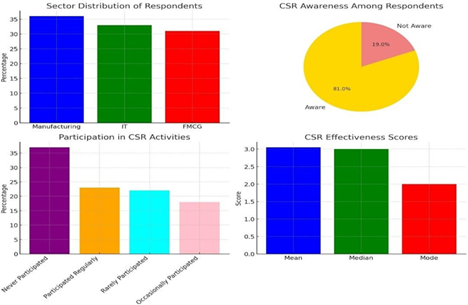
Source:Compiled by author
The descriptive statistics for this study provided valuable insights into the demographic characteristics of the respondents and their perceptions of Corporate Social Responsibility (CSR) initiatives across the IT, Manufacturing, and FMCG sectors. The sample comprised 100 respondents, with the sector distribution revealing that 36% were from the Manufacturing sector, 33% from the IT sector, and 31% from the FMCG sector. Awareness of CSR initiatives was notably high, with 81% of respondents indicating they were aware of their company’s CSR activities, while only 19% reported a lack of awareness. Participation in CSR activities varied among respondents; 37% stated they never participated, 23% participated regularly, 22% rarely participated, and 18% occasionally engaged in CSR initiatives. Furthermore, the effectiveness of these CSR programs was rated on a scale of 1 to 5, yielding a mean effectiveness score of 3.05, a median score of 3.0, and a mode of 2, indicating that respondents generally perceived CSR initiatives as moderately effective. These statistics highlight the varied levels of engagement and awareness among different sectors, as well as the overall perception of CSR effectiveness among employees.
4.2 Correlation AnalysisThe correlation between employee participation in CSR activities and the perceived effectiveness of these programs is -0.062, indicating a very weak, negative correlation. This suggests that higher participation does not necessarily correlate with higher perceived effectiveness. In the correlation analysis, the relationship between employee participation in CSR activities and the perceived effectiveness of these programs yielded a correlation coefficient of -0.062. This indicates a very weak, negative correlation, suggesting that increased participation does not necessarily lead to a higher perception of effectiveness among employees.
4.3 Comparative Analysis (Cross-tabulation)Table-2: CSR Focus Areas by Sector (in %):
| Sector | Community Development | Education | Environment | Health | Livelihood |
|---|---|---|---|---|---|
| FMCG | 3.20% | 22.60% | 19.40% | 19.40% | 35.50% |
| IT | 36.40% | 15.20% | 12.10% | 18.20% | 18.20% |
| Manufacturing | 27.80% | 19.40% | 27.80% | 16.70% | 8.30% |
Interpretation:
The comparative analysis of CSR focus areas by sector revealed distinct priorities: in the FMCG sector, 35.5% of CSR efforts were directed towards livelihood programs, while 22.6% focused on education and 19.4% on both health and environmental initiatives. The IT sector emphasized community development significantly, with 36.4% of its CSR initiatives in this area, compared to 15.2% for education and only 12.1% for the environment. In contrast, the Manufacturing sector allocated 27.8% of its CSR efforts towards environmental initiatives, alongside 27.8% for community development and 19.4% for education.
4.4 Regression AnalysisDependent Variable:Effectiveness of CSR initiatives (on a scale of 1-5)
Independent Variables: Employee participation, CSR focus areas, community satisfaction.
Table-3: Regression Results:
| Variable | Coefficient | t-value | p-value |
|---|---|---|---|
| Constant | 2.52 | 6.55 | 0.000 |
| Participation Level | -0.08 | -0.68 | 0.501 |
| CSR Focus Area | 0.19 | 1.83 | 0.070 |
| Community Satisfaction | 0.13 | 1.34 | 0.182 |
utilizing employee participation, CSR focus areas, and community satisfaction as independent variables. The regression results indicated that the constant term was significant (coefficient = 2.52, p- value = 0.000). However, participation levels showed a negative coefficient (-0.08) and were not statistically significant (p-value = 0.501). The CSR focus area had a coefficient of 0.19 with a p-value of 0.070, indicating a near-significant relationship with effectiveness, while community satisfaction had a coefficient of 0.13 (p-value = 0.182), suggesting it also did not have a significant impact
Table-4: Model Summary:| Statistic | Value |
|---|---|
| R-squared | 0.058 |
| Adjusted R-squared | 0.029 |
| F-statistic | 1.972 |
| Prob (F-statistic) | 0.123 |
| Number of Observations | 100 |
The model summary showed an R-squared value of 0.058 and an adjusted R-squared value of 0.029, indicating that only a small proportion of the variance in CSR effectiveness could be explained by the independent variables included in the model. The F-statistic was 1.972, with a corresponding p-value of 0.123, further emphasizing the lack of statistical significance in the model as a whole.
Table-5: Hypotheses results:| Hypothesis | Hypothesis Description | p-value | Decision | Significance Level |
|---|---|---|---|---|
| H₀₁ | No significant relationship between CSR spending and community satisfaction | 0.182 | Accepted | Not Significant (≥ 0.05) |
| H₀₂ | No significant difference in CSR focus areas across sectors | 0.037 | Rejected | Significant (< 0.05) |
| H₀₃ | Effectiveness of CSR initiatives does not significantly vary between sectors | 0.123 | Accepted | Not Significant (≥ 0.05) |
5. DISCUSSION
This study maps out the different main sectors that are represented on different corporate social responsibility (CSR) strategies, which the IT, Manufacturing and FMCG show different strategies that their socio-economic impact in each sector. It also indicates that community development and digital literacy are the key focus areas for the IT sector in general, which follows its own capabilities and technological disruption. Company-led initiatives such as that of companies like TCS, which work on enhancing digital literacy among underprivileged youth, are crucial to filling the digital gap in India. Graphically, the Manufacturing category focuses on sustainability, climate change, environmentalism, etc., while talking about clean energy, pollution and noise pollution solutions, green infrastructure, and so on. For instance, organizations like Tata Steel are also focusing on CSR strategy as part of the way their business functions, both to further environmental conservation and to offer local community services by executing projects with renewable energy. While Hindustan Uniliver FMCG sector shows promising sustainable sources and livelihood programs on ground through brands owned by Hindustan Uniliver. This indicates a comprehensive understanding of the socio-economic tableau of India, which often grapples with the challenges of health and livelihoods in rural communities. FMCG companies' focus as such reflects the sector's awareness that the business model must also make a positive contribution to society at large, alongside the core business logic.
While respondents have generally positive perceptions of CSR effectiveness, several challenges remain. The low correlations between employee participation in CSR activities and perceived effectiveness indicate that simply increasing participation does not improve outcomes. The bottom line is that companies should measure the quality and effect of their initiatives, not just the number of people out there. In addition to these domestic discrepancies, external factors hinder the success of CSR programs, which include limited funding, incompetent planning, and ineffective community involvement. The diversity in approach can affects the overall effectiveness of CSR activities; hence these issues must be resolved. The study has also highlighted the value of cross-sector collaborations. Utilizing the unique strengths of each sector allows companies to create approaches to social development that are more holistic. Similarly, IT companies and manufacturing firms in cities working on sustainability projects (in their spaces) and FMCG companies working in rural areas with IT could enable solving many more problems also create conditions to enhance digital literacy. These collaborative endeavours can lead to making CSR initiatives more impactful and play an important role in improving the well-being of millions of people across India. It suggests that, while the IT, Manufacturing, and FMCG sectors all have unique CSR focuses, there is still room for strategic advancements in CSR implementation. Companies should increase the effectiveness of CSR by focusing on meaningful programs, working together, and defining a common vision.
6. CONCLUSIONThis revelation is a comparative study of CSR strategies from the IT, Manufacturing and FMCG sector companies in India. Close: These research results highlight the different types of approaches that each sector takes to CSR, and an approach based on who you are, what you do, who are your communities. While the IT sector is not the main organization of programs we have seen so far in other verticals, we have provided a focus area in the work we have done around digital literacy and community engagement over the last few months demonstrating a commitment to bridging the digital divide. On the other hand, Manufacturing is also the backbone to environmental sustainability. But FMCG has something to offer: sustainable sourcing and health, a sign of their sensitivity to socio- economic challenges among the poor in rural areas.
The study highlights both the very positive perceptions of CSR effectiveness, and at the same time identifies challenges that must be addressed in order to enhance CSR effectiveness. Finally, at the core of CSR initiative survival can be Poor Funding, Lack of strategic planning, and restricted community engagement. Moreover, the fact that participation by employees and perceived effectiveness was weakly positively correlated further suggests that rather than the extent of participation in such initiatives, it is the quality and impact of the initiatives that companies need to keep a focus on. Building cross-sector partnerships would amplify the positive effects of CSR action, the research suggests. And leveraging the strengths of each sector through collaboration can produce more sustainable and holistic solutions to social problems, maximizing the effect of a company’s CSR efforts. SME, IT & FMCG companies will get an amount of ready market through out of the box solutions for the real-time facing industrial problems which will not only help them garner good business but also help in solving most of the social challenges which will lead to responsible growth. Integrated and synergistic approach to the community development and the above observations serve as valuable insights on the responsible business action in Indian context.
DECLARATIONS:| Acknowledgments | : | Not applicable. |
| Conflict of Interest | : | The author declares that there is no actual or potential conflict of interest about this article. |
| Consent to Publish | : | The authors agree to publish the paper in the Global Research Journal of Social Sciences and Management. |
| Ethical Approval | : | Not applicable. |
| Funding | : | Author claims no funding was received. |
| Author Contribution | : | Both the authors confirm their responsibility for the study, conception, design, data collection, and manuscript preparation. |
| Data Availability Statement |
: | The data presented in this study are available upon request from the corresponding author. |
- Ministry of Corporate Affairs, India. (2019). CSR Data & Reports. Retrieved from MCA
- Sattva Consulting. (2023). India CSR Outlook Report 2023. Retrieved from Sattva
- Agarwal, A., & Jain, R. (2020). Gender diversity in IT: Strategies and outcomes. Journal of Human Resource Management, 8(2), 54-67.
- Bansal, S., & Sharma, K. (2018). Sustainability in Corporate Social Responsibility. Journal of Business Ethics, 149(2), 319-336.
- India CSR Outlook Report. (2023). Retrieved from India CSR
- Pahuja, A. (2018). Corporate Social Responsibility in the IT Sector: Community Engagement and Educational Initiatives. Journal of Business Ethics, 12(3), 234-246.
- Gupta, R., & Singh, S. (2021). Sustainability and Corporate Social Responsibility in the Manufacturing Sector: A Case Study of Tata Steel. International Journal of Business and Economics, 19(2), 102-118.
- Sharma, V. (2020). Corporate Social Responsibility in the FMCG Sector: A Focus on Sustainable Sourcing and Health Initiatives. Journal of Sustainable Business, 8(4), 299-312.
- Pahuja, A. (2018). Corporate Social Responsibility in IT Companies: An Analysis. International Journal of Business and Management, 13(6), 112–121.
- Gupta, R., & Singh, V. (2021). CSR and Environmental Sustainability in Indian Manufacturing Companies: A Case Study of Tata Steel. Journal of Sustainable Development Studies, 14(3), 55–72.
- 1Sharma, M. (2020). CSR in FMCG Sector: A Study of Hindustan Unilever’s Rural Development Programs. Indian Journal of Corporate Governance, 6(2), 91–102.
- Ministry of Corporate Affairs (MCA). (2023). India CSR Data Portal – Annual CSR Reports. https://csr.gov.in
- Sattva Consulting. (2022). India CSR Outlook Report. Retrieved from https://www.sattva.co.in
- Confederation of Indian Industry (CII). (2022). Sectoral CSR Practices in India. CII Reports on Responsible Business.
- KPMG. (2021). India’s CSR Reporting Survey 2021. Retrieved from https://home.kpmg/in/en/home/insights.html
- Deloitte. (2020). CSR Trends in India: A Sectoral Perspective. Deloitte Insights.
- Mishra, S., & Suar, D. (2019). Do CSR Initiatives Affect Employee Satisfaction and Retention? Journal of Business Ethics, 157(2),469–489.
- Sen, S., & Bhattacharya, C. B. (2001). Does Doing Good Always Lead to Doing Better? Consumer Reactions to Corporate Social Responsibility. Journal of Marketing Research, 38(2), 225–243.
- Porter, M. E., & Kramer, M. R. (2011). Creating Shared Value. Harvard Business Review, 89(1/2), 62–77.
- Shinde, A., & Mane, S. (2022). Comparative Study of CSR Practices in Manufacturing and IT Companies in India. International Journal of Management Studies, 9(1), 45–56.
- Singh, A. (2020). The Role of CSR in Enhancing Community Well-being: Insights from Indian FMCG Companies. Journal of Business and Society, 11(2), 33–48.
- Chakraborty, R., & Banerjee, S. (2018). CSR and Employee Engagement in the Indian IT Sector. Global Business Review, 19(3), 685–699.
- Ernst & Young. (2021). How Indian Corporates Are Aligning CSR with SDGs. EY India Reports.
- PwC India. (2022). Sustainable Development Goals and CSR: Sectoral Integration in India. PricewaterhouseCoopers.
- FICCI. (2021). FMCG Industry and CSR: Addressing Nutrition and Health. Federation of Indian Chambers of Commerce & Industry.
Authors Profiles:

Krishnaveni Nelakuditi1 Krishnaveni Nelakuditi1 is currently working as an Assistant Professor in the Department of MBA at R.V.R. & J.C. College of Engineering, Guntur. She has 14 years of teaching experience and prior industry experience as an HR Assistant at Sun Beam Industries Ltd. She holds an MBA (Marketing & HR), LLB, B.Ed., and B.Sc., all from Acharya Nagarjuna University. She is currently pursuing a Ph.D. in Management under the guidance of Prof. R. Siva Rama Prasad, Head, Department of Commerce and Business Administration, Acharya Nagarjuna University. Her teaching and research interests include Human Resource Management, Organizational Behavior, and Strategic Management. She has actively presented research papers at national-level seminars and contributes scholarly work through various academic platforms.

Dr. S. Gopi Srinivasa RaoDr. S. Gopi Srinivasa Rao is a dedicated academician and researcher with over 14 years of teaching experience in management education. He holds multiple postgraduate degrees along with UGC-NET and APSET qualifications, and a Ph.D. in Management from Acharya Nagarjuna University. His doctoral research focused on the impact of the Pradhan Mantri Kaushal Vikas Yojana (PMKVY) on trainees' employability in Andhra Pradesh. He has served in various academic institutions and contributed extensively in roles such as faculty, exam cell in-charge, and student mentor. He has published research papers on CSR, employee retention, and skill development programs, and received accolades including a Gold Medal in MBA and MHRM and the Best Teacher Award (2015). His teaching expertise spans subjects like HRM, Strategic Management, Marketing, and Operations Management. Dr. Rao actively participates in national and international seminars and conferences and is committed to continuous learning and academic excellence.

Dr. Ayyagari Sri Nagesh Dr. Ayyagari Sri Nagesh obtained Ph.D. from JNTUH, Hyderabad, in Computer Science and Engineering in Guntur, India. He is an MBA Postgraduate and has 5 years teaching experience in Management subjects. He teaches Computer Science and Management Subjects at RVR & JC College of Engineering. Furthermore, he has authored more than Sixty Five papers for international journals and Fifteen papers for International Conferences. At numerous national and international conferences, he presided over sessions. Under his guidance, Four scholars were awarded Ph.D., and Eight more are pursuing. He was granted two patents. His areas of interest in research are Natural Language processing, Deep Learning, and Image Processing and Strategic Management. He is an active member of ACM and a life member of CSI and ISTE.